Dec 30, 2025

4 min read


So, you have a great app idea, but one big question is looming: how much is this going to cost? When it comes to React Native app development cost, the price tag can land anywhere between $8,500 for a simple app to over $250,000 for a complex enterprise solution. It's a huge range, and the final number really boils down to your app's features, design complexity, and the team you choose to build it.
The main thing to remember is that choosing React Native can be a much friendlier option for your wallet than building two separate native apps from the ground up.
Trying to pin down the investment for a new mobile app can feel like you're navigating a maze in the dark. You know where you want to go, but the path is murky with budget unknowns. React Native shines a light on that path by changing the fundamental economics of development.
Instead of the old way—building one app for iOS and another for Android, which means two teams, two codebases, and double the work—React Native lets you build once and deploy everywhere. This "write once, run anywhere" philosophy is exactly why it's become a go-to for everyone from scrappy startups to established giants. It's not just about saving money upfront; it’s about launching faster and making your life easier when it comes to maintenance down the road.
The secret sauce is the shared codebase. Real-world data shows that using React Native can slash development expenses by a massive 25-50% compared to traditional native development. That efficiency translates directly into time and money saved, often shrinking development timelines by 4-6 months.
To put some numbers on it:
One of the smartest ways to amplify these savings is to accelerate the initial build. This is where production-ready templates and UI kits come in.
By starting with a pre-built foundation, your team can bypass months of foundational work on common features like user authentication, settings screens, or navigation. Instead, they can focus their energy and your budget on what makes your app unique.
Platforms like gluestack market offer a whole range of these templates, giving you a serious head start that dramatically lowers your initial investment. Think of it as buying a high-quality pre-fabricated frame for a house instead of milling the lumber yourself. You still get to design all the important stuff inside, but you get to move in much faster and for less money.
To give you a clearer picture, here's a quick breakdown of what you can expect to invest based on your project's scope.
This table summarizes the typical costs and development timelines you can expect for a React Native app, broken down by its overall complexity.
| App Complexity | Estimated Cost Range | Estimated Timeline |
|---|---|---|
| Simple (MVP) | $8,500 – $25,000 | 2 – 4 Months |
| Medium Complexity | $25,000 – $65,000 | 4 – 8 Months |
| Complex (Enterprise) | $65,000 – $250,000+ | 8+ Months |
As you can see, the jump from a simple Minimum Viable Product (MVP) to a feature-rich enterprise app is significant, both in terms of budget and time. This is why a clear project scope is your best friend when it comes to managing costs.
Trying to nail down the exact React Native app development cost can feel a bit like guessing the price of a custom-built house before you've even talked to an architect. You wouldn't expect a single "house fee"—you know the cost depends on the blueprints, the foundation, how many rooms you want, the fancy finishes, and all the wiring that makes it work. An app budget is exactly the same.
Every decision you make, from a simple login screen to a sophisticated real-time chat, adds another line item to the final bill. These individual choices are what really shape your overall investment. If you understand them, you can start making smart trade-offs between your dream features and your budget, putting your money where it will have the biggest impact.
This is the big one. The scope and complexity of your app's features are hands-down the most significant cost driver. A basic app with some static text and simple navigation is like a cozy one-bedroom starter home—totally functional and relatively affordable. On the other hand, a complex e-commerce platform with live inventory tracking and AI-powered recommendations is more like a multi-story mansion packed with smart home tech.
To give you a clearer picture, here’s how different features can make your budget climb:
When you break it down by phase, you can see where the money really goes. The design phase alone often eats up 10-20% of the budget. The core development work? That’s the bulk of it, typically 50-70%. Adding in complex features like media streaming or m-commerce can easily push a project into the $80,000-$300,000 range. For a deeper dive into these numbers, the team at Topflight Apps has some great insights about app development costs.
How your app looks and feels is another major line item on the invoice. A clean, straightforward interface that uses standard, native-style components is the most efficient and cost-effective route. But if you're chasing a completely unique brand experience with custom animations, slick transitions, and a highly polished visual identity, get ready for a much bigger investment in design.
A great user experience isn't just about looking good; it's about making the app intuitive and enjoyable. This requires serious time from skilled UI/UX designers for research, wireframing, prototyping, and user testing—all of which contribute to the final cost.
The backend is the engine humming under the hood of your app. It’s the invisible but absolutely essential part that manages data storage, user accounts, and all the server-side logic. A simple, content-driven app might get away with a basic backend, but as your feature list grows, so does the need for a more powerful and scalable infrastructure.
Think about these core backend components:
Finally, don't make the classic mistake of forgetting about ongoing costs. Your app isn't "done" at launch. You need to budget for post-launch maintenance, bug fixes, server hosting, and regular updates to keep it secure and running smoothly. These are critical for your app's long-term health and should be part of the financial plan from day one.
Who you hire to build your app is easily one of the biggest drivers of your final React Native app development cost. Think of it like building a custom home. You could bring in a famous architectural firm, hire a local general contractor, or try to manage a team of individual craftsmen yourself. Each path gets you a finished house, but the budget, process, and even the final result will be wildly different.
Choosing your development partner is a similar game of trade-offs between cost, hands-on expertise, and how much management you're willing to do. There’s no single "best" answer here; the right choice really depends on your budget, timeline, and where you see your app going in the long run. Getting this decision right can mean the difference between a smooth launch and a project that completely stalls out.
Bringing developers in-house gives you the absolute most control. This team lives and breathes your product every single day, becoming fully immersed in your company culture and long-term vision. Since they're dedicated only to your project, they build up deep product knowledge, which usually means faster pivots and updates down the line.
But this model also carries the highest upfront and ongoing costs. You have to budget for a lot more than just salaries. You're also on the hook for:
This approach is really best for well-funded companies that see their mobile app as a core, long-term part of their business.
Hiring a development agency is a popular middle-ground. You get instant access to a complete, pre-vetted team—project managers, UI/UX designers, developers, and QA testers are all part of the package. A good agency brings a ton of experience from different projects, offering insights and proven processes that can help you sidestep common roadblocks.
Sure, agencies charge a higher hourly rate than freelancers, but what you're really paying for is a fully managed, turnkey service. They handle all the project logistics, and you get a single point of contact, which cuts your own administrative work down to almost nothing. This is a great fit for businesses that need a high-quality app on a predictable schedule, without the headache of building a team from scratch.
Hiring freelancers is often the most budget-friendly route, especially for smaller projects or if you just need help with a specific feature. You can pull together a "dream team" of specialists from a global talent pool, paying only for the hours they put in. That flexibility is a lifesaver for startups and MVPs where every dollar is being scrutinized.
The big catch? The management overhead falls squarely on you. You become the project manager, juggling communication across time zones, sorting out conflicts, and making sure everyone stays on track. It can be a massive time-sink and helps if you have some technical knowledge yourself. While it's the lowest direct cost, the hidden costs of your own time and potential project delays can sneak up on you.
Your choice of development partner is a strategic decision that balances upfront cost with long-term value. An in-house team offers deep integration but high overhead, an agency provides turnkey expertise at a premium, and freelancers deliver cost-effectiveness at the expense of your own management time.
Beyond the type of team, the location is just as critical. Geographic differences in developer rates have a massive impact on React Native app costs. In Asia, you might find hourly rates in the $20-$40 range, whereas developers in the USA/Canada often command $100-$150. This means a medium-complexity app that costs $50,000 in North America might only be $10,000-$20,000 if outsourced to Asia—a potential savings of over 60%. Europe sits somewhere in the middle at around $50-$80/hour. If you want to dive deeper, you can discover more insights about React Native cost factors.
Ultimately, the best approach is the one that lines up with your resources. For those looking to maximize efficiency, using pre-built solutions can be a game-changer, no matter which team model you choose. If you're interested in getting the most out of your team, check out our guide on how to improve developer productivity. This strategy helps any team—in-house, agency, or freelance—build faster and much more cost-effectively.
The theory behind React Native app development cost is a good starting point, but seeing how those numbers play out in the real world is where the budget really comes into focus. Let's make this tangible by breaking down three common app scenarios, from a lean startup MVP to a feature-rich enterprise platform.
Each example details the features, team, timeline, and estimated costs, giving you a parallel for your own idea. This way, you can move from abstract figures to a concrete financial roadmap for your project.
Imagine you want to build a basic habit tracker. The goal isn't to take on giants like Headspace on day one. Instead, you want to launch a Minimum Viable Product (MVP) quickly to test the waters and get real user feedback. The focus here is on core functionality, no frills attached.
For a deeper dive into how costs are itemized across different types of mobile apps, check out this detailed mobile app development cost breakdown guide.
Okay, let's level up. Think of a social networking app for a specific niche, like book lovers or local hikers. This kind of app needs more dynamic features, a more polished design, and a backend that can handle real-time user interactions. It's a big step up from the simple MVP.
This infographic neatly summarizes how different team models—agency, freelance, and in-house—stack up on cost and control.
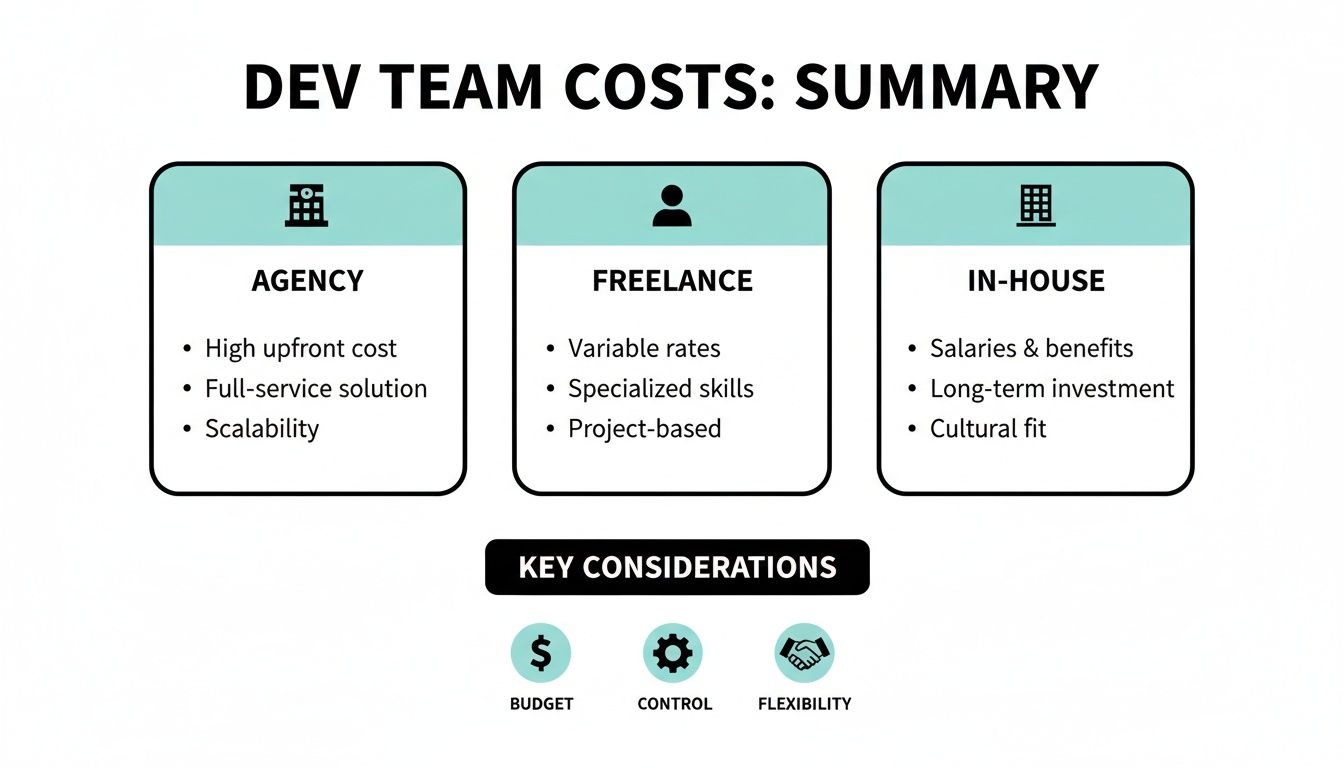
As you can see, there are trade-offs. Agencies offer a full-service package at a premium, freelancers give you cost flexibility but require more management, and an in-house team provides maximum control for the highest long-term investment.
Finally, let's tackle a complex, enterprise-grade app—something like a food delivery or ride-sharing platform. This is a multi-sided marketplace, meaning it needs separate interfaces for customers, drivers/restaurants, and administrators. It involves advanced logic, third-party integrations, and a highly scalable backend.
This is where the investment climbs steeply. The app has to be robust, secure, and perform flawlessly under heavy load, which demands a senior-level development team and extensive infrastructure.
By looking at these varied examples, you can get a much better feel for where your own project might land. If you need a little more inspiration, you can explore a collection of excellent React Native app examples to see what's possible with the framework.
Knowing what drives up your React Native app development cost is one thing. Knowing how to actually control those costs is where the real magic happens. With a few smart decisions, you can dramatically lower your final bill without gutting your core vision.
Think of it like packing for a big trip. You can’t bring everything, so you focus on the absolute essentials. It's the same with app development—you prioritize features, lean on existing resources, and build on a solid foundation to avoid doing the same work twice.
The single best way to slash costs is by adopting a Minimum Viable Product (MVP) mindset. Forget about building every bell and whistle for your initial launch. Instead, you build only the core features that solve one primary problem for your users.
This ruthless focus does more than just save you a ton of money upfront. It’s the fastest way to get real-world validation for your idea. Launching a lean MVP lets you collect actual user feedback, ensuring every dollar you spend afterward goes toward features people genuinely want. In fact, an MVP strategy can slice initial development costs by as much as 55%.
Why build something from the ground up when a battle-tested solution already exists? Tapping into third-party APIs for common functions is a massive time and money saver.
The React Native ecosystem is also packed with open-source libraries that offer pre-built components for everything from navigation to slick animations. Using these lets your developers focus their brainpower on your app's unique secret sauce.
Your development team's time is your most valuable asset. By using pre-built APIs and open-source code, you direct their expertise toward custom features that differentiate your product, rather than reinventing the wheel on standard functionalities.
While APIs and libraries are perfect for specific features, the biggest jump in efficiency comes from using comprehensive, production-ready templates and UI kits. This is the ultimate shortcut to reducing your React Native app development cost.
Starting with a high-quality template is like being handed the keys to a house that’s already framed, wired, and plumbed. You skip months of foundational work and get right to the fun part: designing the interior and adding the unique touches that make it yours.
Platforms like gluestack market offer professionally designed and coded templates for all sorts of apps, from fitness trackers to fintech platforms. These kits give you a complete, stable foundation right out of the box, including:
Take a look at how this plays out in a real-world scenario. Building from scratch means your team has to handle everything, from basic UI to complex backend integrations. A template gives you a massive head start.
| Development Phase | Cost From Scratch | Cost With A Template | Potential Savings |
|---|---|---|---|
| UI/UX Design & Prototyping | $5,000 - $15,000 | $500 - $2,000 | Up to 90% |
| Frontend Development (Core Screens) | $10,000 - $25,000 | $2,000 - $5,000 | Up to 80% |
| Navigation & State Management | $4,000 - $8,000 | $0 (Included) | 100% |
| Basic Backend Integration | $6,000 - $12,000 | $1,000 - $3,000 | Up to 83% |
| Total Estimated Cost | $25,000 - $60,000 | $3,500 - $10,000 | ~$21,500 - $50,000+ |
The numbers speak for themselves. By using a template, your team can cut development time by hundreds of hours, which directly translates into huge cost savings. This approach shifts your budget away from building boilerplate code and toward actual innovation. For those looking to dive deeper, our guide on choosing the right mobile app templates offers more on this powerful strategy.
Ultimately, the goal is to work smarter, not harder. To maximize efficiency and protect your budget, it's crucial to implement practical strategies to reduce software development costs from the very beginning.
Before you dive headfirst into development, you need a solid financial game plan. Think of this as your pre-flight check—a structured way to move from a high-level idea to a concrete budget, making sure you account for all the critical moving parts.
Getting this right from the start helps you make informed decisions, dodge costly surprises down the road, and make sure every dollar you spend pushes your business goals forward.
First things first: get ruthless about your Minimum Viable Product (MVP). An MVP isn't just a watered-down version of your dream app. It's the absolute leanest version that solves one core problem for your ideal user.
This single step is your most powerful cost-control tool. A tightly focused MVP can easily slash initial development costs by over 50%, letting you validate your idea in the market without betting the farm on unproven features.
Next up, you need to figure out who is going to build this thing and where they’re located. As we've already covered, developer rates are the single biggest variable in your entire budget.
Jumping into the world of app development costs can feel a bit like navigating a maze. You’ve got questions, and we've got answers. Let's clear up some of the most common queries about budgeting for your React Native project.
More often than not, yes, but it's not a silver bullet. The biggest win with React Native is its "write once, run anywhere" nature. You build one core codebase for both iOS and Android, which can slash development hours and shrink your team size, especially for apps with fairly standard features.
But the plot thickens with highly complex apps. If you need deep, platform-specific integrations—think advanced camera controls, intricate background processing, or custom-built native UI components—your developers will have to dive into native code anyway. In those edge cases, the cost savings start to shrink, though you’ll still gain a ton of efficiency from the shared code that runs the rest of your app.
Hitting "publish" on the app stores isn't the finish line; it's the starting line for your app's life in the wild. Ongoing maintenance is absolutely critical to keep your app secure, running smoothly, and keeping users happy.
A good rule of thumb is to set aside 15-20% of your initial development cost for maintenance each year.
So, what does that budget actually cover?
Absolutely—if you've got the technical chops and the time to spare. Going the DIY route is the ultimate cost-saver on paper because you're cutting out all the labor costs. But it's not a walk in the park. You'll need to be comfortable with JavaScript, understand React principles, and have a handle on mobile development basics.
For founders and solo devs who know their way around code, using a pre-built template is a game-changer.
Think about it: a production-ready template can knock out 60-80% of the foundational work for you. We're talking user authentication screens, navigation, a solid UI library—all the stuff you have to build but doesn't make your app unique. This frees you up to focus on the features that actually matter to your users, not the boilerplate.
It’s the perfect middle ground: you save a ton of money without having to build every single thing from scratch, which drastically cuts down your time to launch.
Ready to get a massive head start on your app? gluestack market has a huge collection of production-ready React Native templates. Check them out at https://market.gluestack.io and see how fast you can bring your idea to life.
Feb 23, 2026
4 min read
Discover powerful mobile app monetization strategies to boost your revenue. Our guide covers IAPs, ads, and subscriptions for React Native apps and beyond.

Feb 22, 2026
4 min read
A clear guide to app development cost estimation. Learn what drives costs, see budget examples, and discover strategies to build your app for less.

Feb 21, 2026
4 min read
Discover how to promote mobile application effectively with proven ASO, paid campaigns, and retention strategies.

Feb 15, 2026
4 min read
Discover how to create a prototype of a website with a practical, step-by-step guide. Explore tools, testing methods, and tips to bring your idea to life.
Feb 14, 2026
4 min read
Confused about mockups vs wireframes? Learn the key differences, when to use each, and how to streamline your React Native app development workflow.

Feb 13, 2026
4 min read
Discover how mobile apps templates accelerate development. Learn to choose, customize, and deploy high-quality React Native templates for your next project.

Feb 12, 2026
4 min read
Explore mobile application interface design with practical tips, core principles, and platform-aware workflows to craft apps users love.

Feb 10, 2026
4 min read
Learn mobile first design principles to craft fast, accessible apps that delight users. Practical tips, examples, and testing strategies.
Feb 08, 2026
4 min read
Explore the progressive web app vs native debate with our in-depth guide. We compare performance, cost, and UX to help you make the right strategic choice.
Feb 07, 2026
4 min read
Discover how React Native templates can accelerate your app development. This guide explores choosing, customizing, and deploying templates for faster launches.
Feb 05, 2026
4 min read
Discover the key differences between expo vs react native, including workflow, builds, and performance to help you pick the right path for your app.
Feb 03, 2026
4 min read
Master image with text overlay in React Native with responsive, accessible patterns. Learn expo setup, NativeWind styling, and gluestack-ui examples.

Feb 03, 2026
4 min read
Discover cross platform app development with proven strategies to build faster for iOS, Android, and the web using a single, unified codebase.

Feb 01, 2026
4 min read
Learn how to make an app for my business quickly with template-based steps from planning to launch, plus tips to scale and optimize.

Jan 31, 2026
4 min read
Ready to build an app? This guide shares practical strategies for validating your idea, choosing a tech stack, and navigating the App Store launch.
Jan 30, 2026
4 min read
Master responsive design for mobile apps with this guide on fluid layouts, breakpoints, and React Native. Build UIs that adapt perfectly to any screen.

Jan 25, 2026
4 min read
Learn how to design an Android app that stands out. This guide covers UX research, wireframing, Material Design, and the developer handoff process.

Jan 24, 2026
4 min read
Explore ui design web essentials: a complete guide to principles, responsive patterns, and workflows for intuitive, engaging web interfaces.

Jan 23, 2026
4 min read
Discover 10 essential mobile app design best practices for building exceptional cross-platform apps. Actionable tips for UI, UX, navigation, and performance.

Jan 21, 2026
4 min read
Discover how to debug React Native apps effectively. This guide covers Flipper, React DevTools, and native code troubleshooting for faster development cycles.

Jan 20, 2026
4 min read
Learn how to create app for your business with a practical, modern approach. Plan, customize, and launch with proven steps.
Jan 19, 2026
4 min read
A complete guide to mobile app development for startups. Learn how to validate your idea, build an MVP, and launch a successful app faster and more affordably.

Jan 18, 2026
4 min read
Discover how to choose the right React website template to accelerate your project. Our guide covers everything from quality checklists to deployment.
Jan 17, 2026
4 min read
Discover how to choose, customize, and deploy a React Native app template. This guide provides practical steps for launching production-ready apps faster.

Jan 16, 2026
4 min read
Discover how mobile application templates accelerate development. This guide covers how to choose, customize, and launch your app with the right foundation.

Jan 13, 2026
4 min read
Start your journey in mobile app development for beginners. This guide breaks down how to build your first cross-platform app with React Native and Expo.

Jan 12, 2026
4 min read
Explore the best react native ui libraries and compare features, performance, and ease of use to pick the right toolkit for your app.

Jan 11, 2026
4 min read
Launch your own ride-hailing service with our guide to building a production-ready Uber app clone. Learn MVP strategy, tech stacks, and backend integration.
Jan 10, 2026
4 min read
Master modern cash app design with this guide. Learn the UI/UX, security, and React Native strategies needed to build a fintech app that users trust and love.
Jan 09, 2026
4 min read
Learn how to build a personal finance dashboard with React Native. A practical guide for developers on UI design, data architecture, and production readiness.
Jan 08, 2026
4 min read
A practical guide to building a cross-platform event check in app with React Native. Learn to implement QR scanning, offline sync, and deployment.

Jan 07, 2026
4 min read
Master linear gradient React Native components with our complete guide. Learn practical techniques for Expo, bare RN, and NativeWind to build stunning UIs.

Jan 06, 2026
4 min read
Learn how to change application name in your React Native & Expo projects. This guide covers display names, package IDs, and app store listings.

Jan 05, 2026
4 min read
Discover how to monetize mobile apps with our founder's guide. Learn proven React Native strategies for ads, IAPs, and subscriptions to maximize your revenue.

Jan 04, 2026
4 min read
A practical guide on how to create a website app with a single codebase. Learn to build for web, iOS, and Android using React Native, Expo, and TypeScript.

Jan 03, 2026
4 min read
Learn how to create an app for your business with this definitive guide. Discover practical strategies for validation, development, and launch that work.

Jan 02, 2026
4 min read
Learn how to create a wireframe for a website with this practical guide. Move from initial sketches to developer-ready designs that get built right.
Jan 01, 2026
4 min read
Deciding on progressive web application vs native? This guide offers a deep comparison of performance, cost, UX, and use cases to help you choose wisely.

Dec 31, 2025
4 min read
Discover 10 mobile app security best practices for React Native. Learn to secure data, APIs, and code with actionable tips and examples for 2025.

Dec 29, 2025
4 min read
A practical guide to master your React Native debug workflow. Learn to use Flipper, React DevTools, and Hermes to solve bugs in Expo and bare RN apps.

Dec 28, 2025
4 min read
The ultimate React Native tutorial for beginners. Learn to build beautiful cross-platform apps using a modern stack like Expo, TypeScript, and gluestack-ui.

Dec 27, 2025
4 min read
A practical guide on how to build a mobile app. Learn to go from concept to a market-ready app using templates, React Native, and proven development strategies.

Dec 26, 2025
4 min read
Discover interface design for websites with actionable tips on layout, responsiveness, and usability to boost conversions.

Dec 25, 2025
4 min read
Discover designs for apps that blend minimal aesthetics with personalization, and learn to build user-centric interfaces that boost engagement.

Dec 24, 2025
4 min read
Learn graphical interface design - essentials for mastering core principles, modern workflows, and cross-platform strategies to build intuitive, engaging UIs.

Dec 23, 2025
4 min read
Discover how high fi wireframes bridge the gap between ideas and code. Learn a practical workflow for creating, testing, and handing off effective UI designs.

Dec 22, 2025
4 min read
Discover mobile app interface design with practical principles, accessibility, and workflows that boost user engagement.

Dec 21, 2025
4 min read
Explore the top 10 UI UX design trends for 2025. Get expert insights and practical React Native tips to build next-gen cross-platform apps that stand out.

Dec 20, 2025
4 min read
Discover how mobile app templates accelerate development from idea to launch. Learn to select, customize, and deploy templates for a faster time to market.

Dec 18, 2025
4 min read
Explore the best react native ui libraries to accelerate mobile development with performance, theming, and accessibility. Expert tips inside.

Dec 16, 2025
4 min read
Master React Native PDF handling. Learn to generate, view, and share PDFs with practical code examples, library comparisons, and performance tips.

Dec 15, 2025
4 min read
A practical guide to choosing the right React Native component library. Learn how to evaluate options, avoid common pitfalls, and build apps faster.

Dec 14, 2025
4 min read
Find the perfect React Native UI library for your project. This guide compares top libraries, selection criteria, and customization strategies.
Dec 13, 2025
4 min read
Learn how to change app name in React Native and Expo. Our guide covers display names, bundle IDs, and store listings for iOS and Android projects.

Dec 12, 2025
4 min read
Discover the best React Native component library for your next project. We compare top libraries on performance, customization, and real-world use cases.

Dec 11, 2025
4 min read
Discover how to choose the right React Native UI kit. This guide covers top kits, selection criteria, and customization to accelerate your app development.

Dec 10, 2025
4 min read
Explore our in-depth guide to find the best React Native UI library. We compare top contenders to help you choose the right fit for your project.

Dec 09, 2025
4 min read
Discover a practical approach to building apps with React Native. This guide covers setup, UI, state management, and testing to help you ship great apps.

Dec 08, 2025
4 min read
android login with facebook: Learn to set up the Facebook SDK, manage tokens, and implement secure authentication across native Android, cross-platform apps.

Dec 07, 2025
4 min read
Master the alert in React Native. Learn to handle platform differences, build custom modals, and apply best practices for a seamless user experience.
Dec 06, 2025
4 min read
keyboardavoidingview react native: Master keyboard handling with KeyboardAvoidingView across iOS, Android, Expo, and TypeScript.

Dec 05, 2025
4 min read
A practical guide to implementing a React Native PDF viewer. Learn to compare libraries, handle native setup, and troubleshoot common issues with real code.

Dec 04, 2025
4 min read
how to validate startup idea: learn proven methods like customer interviews, MVPs, and metrics to confirm market fit.

Dec 03, 2025
4 min read
how to make app like uber: Learn core features, tech stack, development steps, testing, and launch tips.

Dec 02, 2025
4 min read
Build a rock-solid React Native setup. This guide covers Expo vs. Bare workflows, TypeScript, pnpm monorepos, NativeWind, and deployment strategies.

Dec 01, 2025
4 min read
A practical guide to Stripe React Native integration. Learn to set up your server, build payment UIs, handle webhooks, and launch secure mobile payments.

Nov 30, 2025
4 min read
Learn how to master push notifications in React Native. This guide covers setup, best practices, and advanced techniques for engaging your users.

Nov 29, 2025
4 min read
Build powerful location-based apps with our practical guide to react native with google maps. Get setup guides, pro tips, and best practices for iOS & Android.

Nov 28, 2025
4 min read
Explore deep linking react native with a practical guide to configuring URL schemes, universal links, navigation, and testing for Expo and bare apps.

Nov 28, 2025
4 min read
A practical guide to building a scalable React Native design system. Learn to implement tokens, theming, and tools like NativeWind and gluestack-ui.
Nov 26, 2025
4 min read
Learn why react native expo templates speed up your projects with ready-made patterns and practical tips.

Nov 25, 2025
4 min read
Discover how to improve developer productivity with actionable strategies for workflow, tooling, and culture. A practical guide for software engineering teams.

Nov 24, 2025
4 min read
Discover the best cross platform app development tools. Compare top frameworks like Flutter and React Native to build and ship apps faster.

Nov 23, 2025
4 min read
This Expo React Native tutorial provides a hands-on guide to building cross-platform apps. Learn setup, styling with NativeWind, navigation, and deployment.
Nov 22, 2025
4 min read
Build beautiful UIs faster with this guide to Tailwind CSS React Native. Learn setup, styling, and advanced techniques with NativeWind for mobile apps.
Nov 21, 2025
4 min read
Explore our curated list of 7 top-tier React Native app examples. Discover production-ready templates and resources to build your next app faster.
Mar 19, 2025
4 min read
gluestack market offers React Native UI templates to accelerate development. Get customizable, production-ready React Native app templates and Ui kit, some free. Build faster & smarter today!