Jan 01, 2026

4 min read

When you get down to it, the progressive web application vs native debate boils down to a single, critical choice: do you want the lightning-fast, cross-platform reach of the web, or the raw power and deep hardware integration of a native app?
There’s no single right answer. Your decision hinges entirely on whether you need to prioritize maximum accessibility for the widest possible audience or a premium, feature-rich user experience that feels perfectly at home on the device.
Picking between a Progressive Web App (PWA) and a native app isn't really about choosing the "better" technology. It’s a strategic decision. The best path for you comes down to your business goals, who you're trying to reach, your budget, and how fast you need to get to market. We're going to move past a simple pros-and-cons list here and give you a real framework for making that call.

Think of PWAs as supercharged websites. They’re built with standard web tech but are engineered to deliver an app-like feel right from the browser. They're an absolute game-changer for businesses focused on:
On the other side of the coin, you have native apps. These are built from the ground up for a specific operating system, like iOS or Android. They're the premium option when you need an absolutely flawless user experience and serious performance. Going native is pretty much non-negotiable for:
At its core, the trade-off is straightforward: PWAs give you efficiency and reach, while native apps deliver power and a polished, premium feel. Which one offers a better return on investment? That's entirely up to what your product needs to do.
To really nail down these differences, let's look at how they stack up on the most important attributes.
This table cuts through the noise and gives you a quick summary of where each approach shines (and where it doesn't).
| Attribute | Progressive Web App (PWA) | Native App |
|---|---|---|
| Distribution | Found via a web browser URL. It's linkable and indexable by search engines. | Distributed exclusively through dedicated app stores like the Apple App Store and Google Play. |
| Installation | Users get an "Add to Home Screen" prompt right from the browser. No store needed. | Users have to actively search, find, and download it from an app store. |
| Performance | Pretty fast, but ultimately limited by the browser's capabilities. Can feel less smooth for complex jobs. | Fully optimized for the OS, offering the absolute best performance and responsiveness. |
| Hardware Access | Limited access to features like camera and GPS. Push notifications are notably restricted on iOS. | Full, direct access to every piece of device hardware and all OS-level features. |
| Development | One codebase (HTML, CSS, JavaScript) for all platforms. That means lower cost and a faster build. | Requires separate codebases for iOS (Swift/Objective-C) and Android (Kotlin/Java), driving up costs. |
Ultimately, the table highlights the central tension: PWAs are about ease and accessibility, while native apps are about depth and power. Your choice will define not just your development process, but the entire experience your users have with your product.
To really get the full picture in the progressive web application vs native debate, you have to look past the tech specs and see what's happening in the market. This isn't just a theoretical chat anymore; real money and major strategic shifts are driving the conversation forward. This momentum is more than a trend—it's a sign of a fundamental change in how businesses are building their digital products.
The growth behind PWAs is massive and picking up speed. It’s not just developers who prefer them; it’s a direct answer to what the market is demanding: faster, more efficient, and more accessible experiences. The numbers tell a pretty clear story of a technology that’s gone from a niche idea to a core strategy for everyone from global giants to scrappy startups.
The global market for progressive web apps has seen some serious growth, recently valued somewhere between USD 1.3 to 2.2 billion. But the really wild part is the forecast: that number is expected to explode to as much as USD 21.24 billion by 2033. That's a compound annual growth rate (CAGR) of up to 31.0%. This kind of trajectory shows a ton of confidence from businesses that see the clear ROI PWAs bring to the table. You can dive into a detailed PWA market analysis to see just how big this is getting.
A huge part of this expansion comes down to a new way of looking at development costs. Companies are figuring out that PWAs can deliver almost the same functionality as a native app while seriously cutting down on development time and money. This financial upside is a massive motivator for teams to build with a web-first mindset.
By bringing development under a single web-based codebase, businesses can skip the expensive and slow process of building and maintaining separate apps for iOS and Android. This gets them to market way faster, which is a huge leg up in any competitive space.
The rising wave of PWA adoption is tied directly to a new way of thinking about ROI in software. For years, the high price tag of native app development was just seen as the cost of doing business to get a top-tier user experience. But as web tech has gotten better and better, the gap between what a PWA and a native app can do has shrunk for a whole lot of use cases.
This has made product teams stop and rethink what really matters. The core questions have changed:
For many businesses—especially in e-commerce, media, and service industries—the answer to these questions points straight to PWAs. The ability to iterate fast, reach people with a simple URL, and dodge app store fees makes for a powerful business case. This new economic reality isn't just guiding decisions; it's proving that PWA is a future-proof skill for developers and a smart bet for any company looking to scale.
When you get down to the brass tacks of the PWA vs. native debate, the conversation always lands on three things: performance, user experience (UX), and hardware access. These aren't just tech specs on a sheet; they're the very things that define how a user actually feels about your app. This is where the real trade-offs happen.
A native app is built to live on the device's operating system, giving it a direct line to all the processing power it can handle. The result? Silky-smooth animations, instant reactions to user input, and the muscle to chew through graphically intense tasks like complex data visualizations or high-end games without skipping a beat.
PWAs, on the other hand, operate from within a web browser. Modern browsers are incredibly capable, but they still represent a layer between your app and the device's metal. This can sometimes translate into minor delays or animations that aren't quite as fluid, especially when the app is under heavy load.
Native apps have a home-field advantage when it comes to delivering an intuitive experience. They're designed from the ground up to follow the specific UI/UX rules of iOS and Android. Navigation bars, swipe gestures, and menu styles all look and behave exactly how a user expects. This built-in familiarity goes a long way in building trust and flattening the learning curve.
PWAs work hard to mimic this app-like feel, but their platform-agnostic nature means they often settle for a more generic design. The goal is to work everywhere, not to feel perfectly tailored to one specific OS. Since PWAs are built for mobile users first and foremost, a solid grasp of the principles of mobile-first design is absolutely critical to bridging this gap.
The real differentiator is the "feel." A native app feels like a natural extension of the phone itself. Even the most polished PWA can sometimes feel like a top-tier website wearing an app's clothing. It's a subtle distinction, but it can make a huge difference in user engagement.
Despite these differences, the market for PWAs is growing—and fast.
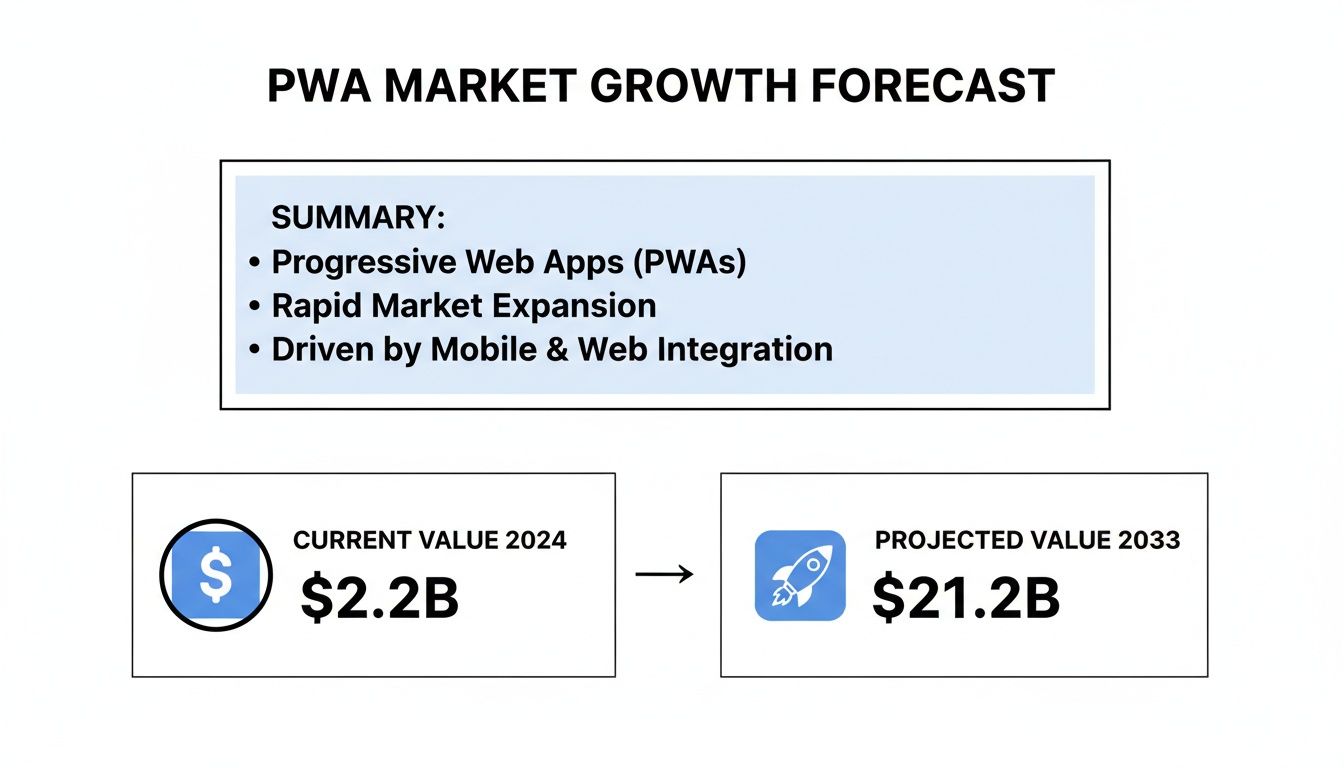
This forecast, which shows the market jumping from $2.2 billion in 2024 to a whopping $21.2 billion by 2033, tells us something important. Many businesses are deciding that the slight UX trade-offs are a fair price to pay for wider reach and dramatically lower development costs.
One of the most talked-about features of PWAs is their ability to work offline, all thanks to service workers. These are little scripts that run in the background, caching key assets and data so the app remains useful even without a solid connection.
A news PWA, for instance, can save articles for you to read on the subway. It's a fantastic feature, but it has its limits. A PWA’s offline mode is mostly about accessing what’s already been saved; complex background jobs like uploading large files or continuously syncing data just aren’t in the cards.
Native apps, however, are built for this stuff. They offer truly robust offline support, capable of running all sorts of background tasks, intelligently syncing data once a connection is back, and offering access to almost every feature. Think of an expense-tracking app that lets you log receipts on a plane and syncs them to the server hours later. That’s a seamless experience PWAs still struggle to match.
The biggest line in the sand between a PWA vs. native app is hardware access. Native apps get an all-access pass to the device’s full suite of features.
This direct pipeline opens up a world of functionality:
PWAs are getting better here, with browser APIs now providing access to basics like the camera, microphone, and GPS. But this access is often guarded, requiring explicit and sometimes repetitive user permission. More importantly, advanced features like Bluetooth, NFC, and deep sensor data remain largely out of reach or are wildly inconsistent—especially on iOS, which keeps web applications in a tight security sandbox. This hardware gap makes native the only real option for any app whose core value depends on deep integration with the device itself.
When it comes down to PWA vs. native, the conversation always lands on two things every business obsesses over: budget and schedule. These two factors can make or break a project, and they represent a major fork in the road when choosing your development path.
The way you build and launch a PWA is worlds apart from a native app, and that difference has massive implications for your initial investment and long-term costs.
The most powerful argument for a PWA is its build-once, run-everywhere efficiency. Because they’re built with standard web tech—HTML, CSS, and JavaScript—you develop a single codebase that works across all platforms. This alone drastically slashes development costs and complexity right out of the gate.
A PWA development cycle is just plain faster. You're essentially giving an existing website a superpower upgrade, not starting from scratch. You don’t need to build and maintain separate apps for iOS and Android, which immediately cuts your engineering effort in half compared to the traditional native route. This is how businesses get a Minimum Viable Product (MVP) out the door in a fraction of the time.
This speed translates directly into a lower financial barrier to entry. You can test your idea, get real user feedback, and pivot on features fast, all without the huge upfront cash dump that native development demands.
A PWA’s single development stream lets your team pour all its resources into one high-quality experience instead of splitting focus and funds across two platforms. It’s a perfect model for startups and businesses that need to move fast and validate their market.
Think about it: a small e-commerce brand could launch a PWA in just a few weeks, giving every single customer an installable, app-like experience from day one. To do the same with native apps, they'd be looking at months of parallel development for both the Apple App Store and Google Play, each with its own frustrating set of rules and review processes.
On the flip side, native app development is a serious upfront investment of both time and money. Building for iOS and Android means wrestling with two completely different codebases, which usually requires specialized developers who live and breathe Swift or Kotlin. This two-track process naturally doubles your timeline and inflates your project costs.
So why on earth would anyone choose the more expensive path? It all comes down to long-term value and creating a killer experience for apps that are heavy on features and performance.
But the spending doesn't stop at launch. Maintaining two separate codebases also means double the work for every update, bug fix, and new feature. Every single change has to be built, tested, and deployed twice, which adds up to a significant long-term resource drain. If you're looking for a clearer picture of these costs, exploring a detailed breakdown of React Native app development cost is a great starting point, especially for teams eyeing cross-platform tools to get the best of both worlds.
Ultimately, the choice between a PWA and a native app isn't just about the initial price tag; it's a strategic decision. PWAs are unbeatable when speed and budget are your top priorities. Native development demands a much bigger commitment, but for complex, performance-hungry applications, it can deliver a superior, highly-tuned experience that pays for itself over time.
Deciding between a PWA and a native app isn't just a technical debate; it's a practical choice that comes down to one thing: what does your application actually need to do? The right path usually becomes pretty clear once you start looking at specific, real-world scenarios where one technology simply outshines the other.

Let's move past the spec sheets and think strategically. It’s all about matching your project’s goals with the best tool for the job.
PWAs are at their best when reach, speed, and content delivery are top priorities. They are the clear winners for businesses that need to get a functional, easy-to-access product in front of the largest possible audience with the least amount of friction.
Think about these situations:
The core strength of a PWA is its ability to combine the discoverability of the web with the convenience of an app. If your primary goal is to lower the barrier to entry for your users, a PWA is almost always the right call.
This is especially true in social media, where grabbing a user's attention fast is everything. The social media segment makes up around 18-19.5% of the PWA market, a figure that makes perfect sense when you consider that 85% of social media usage happens on mobile. With the global smartphone user base hitting 4.88 billion in 2024, the demand for slick, high-performance mobile experiences is only growing, making PWAs an increasingly smart choice for content-first apps.
As flexible as PWAs are, some applications just demand a level of performance and hardware integration that only a native app can deliver. In these cases, the bigger investment is completely justified by the need for a truly top-tier user experience.
A native approach is absolutely essential for:
Ultimately, the choice comes down to your priorities. If you need maximum reach and fast deployment for a content-driven service, the PWA is your answer. But if your app's core value is tied to blistering performance and deep hardware access, going native is the only way to deliver the quality experience your users expect.
When you get deep into the progressive web application vs native debate, it's easy to think there are only two choices. But what if you don't have to pick between web reach and native power? There's a powerful middle ground that many smart teams are taking: cross-platform development.
This whole approach is designed to break the deadlock. You can skip the pain and expense of building separate iOS and Android apps, and you don't have to settle for the performance trade-offs of a web-based PWA. Instead, you get a single, unified path forward.
In this space, React Native has become a major player for a good reason. It lets your team build genuinely native user interfaces for both iOS and Android using a single JavaScript or TypeScript codebase. This isn't just a website stuffed into an app shell; React Native code actually compiles down to the real, native UI components, giving you performance that’s practically identical to an app built the old-fashioned way.
This directly solves the biggest headaches of both PWA and native development:
It's a way to build a high-quality, native-feeling app for both major platforms without doubling your workload and budget.
The real magic of a cross-platform solution like React Native is that it delivers a premium, native user experience while keeping the development process as efficient as a PWA. You're getting the best of both worlds without paying the full price for either.
The ecosystem around frameworks like React Native has grown up, making this approach even more powerful. Marketplaces for UI kits and templates give you a massive running start, letting your team skip months of foundational work and jump straight into building the features that make your app unique.
This is what a marketplace for pre-built React Native components looks like.
Platforms like gluestack market offer production-ready templates already optimized for iOS, Android, and the web, all built with accessible components and clean code. Instead of architecting login screens, dashboards, or e-commerce flows from the ground up, you can grab these pre-built, fully functional pieces and plug them right into your project.
This component-first strategy can radically cut your time to market. It circles back to the core PWA vs. native argument by giving you a path to a top-tier native product with an efficiency that makes it a real contender against a PWA. You can find a whole range of powerful cross-platform app development tools that help close this gap, letting you launch faster without cutting corners on user experience. This hybrid strategy completely changes the game for how product teams can think about building apps.
When product teams get down to the wire, the PWA vs. native debate always brings up a few key questions. These aren't just about features on a list; they're about the real-world impact of the path you choose. Getting these answers right is what separates a smart decision from a costly one.
For a lot of apps, absolutely. But it's not a universal "yes." The real question is, what does your product need to do? PWAs are fantastic for e-commerce, media, and any service where getting content to users quickly and easily is the main goal. Think broad reach, low friction.
But there's a hard line. Native apps still hold the keys to the kingdom when it comes to advanced hardware features—think Bluetooth, NFC, and complex sensor data. If the core of your app is about pairing with a smart watch or using tap-to-pay, native is the only way to go.
Here's a good rule of thumb: If your app's job is mostly to show information or handle transactions, a PWA is a very strong contender. If it has to interact with the physical world through the device's hardware, you're building a native app. Period.
The biggest difference comes down to where they live and operate. A PWA is confined to the web browser's sandbox. This is a massive security win by design, as it keeps the web app walled off from your device’s core operating system and files, shutting down a ton of common attack vectors.
Native apps, on the other hand, are installed right onto the OS. They get more power, but that power comes with more responsibility and a bigger target for threats. While they can use more advanced security tools like certificate pinning to fend off man-in-the-middle attacks, they also have to be built meticulously to protect user data.
This is the classic cage match: App Store Optimization (ASO) vs. Search Engine Optimization (SEO). A PWA is just a website at its core, so it's discoverable on Google. You can use all the SEO and content marketing tricks in the book to pull in a huge organic audience with a simple link.
Native apps are locked inside the gardens of the Apple App Store and Google Play. To get found, you have to master ASO—tweaking your app's name, keywords, and description to climb the search rankings. The app stores provide a trusted, curated space, but they also create friction. A user has to actively look for you, decide to download, and then wait for the install.
Yes, and it's a pretty common playbook. Lots of teams launch a PWA first to test the waters and grab an early user base without a huge upfront investment. If things take off and you find you need native features, you can make the switch.
Usually, this is done with a "wrapper" like Capacitor, which packages your PWA into a native shell. This gets you into the app stores and gives you access to some native APIs. It’s a faster route than a complete rebuild, but just know it might not give you the same buttery-smooth performance or deep hardware access as a true native app.
If you're looking to get the best of both worlds right from the start, gluestack market is your answer. We offer production-ready React Native templates that give you one codebase with the performance and feel of a true native app. You can launch on both iOS and Android without making compromises. Check out our templates at https://market.gluestack.io.
Feb 23, 2026
4 min read
Discover powerful mobile app monetization strategies to boost your revenue. Our guide covers IAPs, ads, and subscriptions for React Native apps and beyond.

Feb 22, 2026
4 min read
A clear guide to app development cost estimation. Learn what drives costs, see budget examples, and discover strategies to build your app for less.

Feb 21, 2026
4 min read
Discover how to promote mobile application effectively with proven ASO, paid campaigns, and retention strategies.
Feb 15, 2026
4 min read
Discover how to create a prototype of a website with a practical, step-by-step guide. Explore tools, testing methods, and tips to bring your idea to life.
Feb 14, 2026
4 min read
Confused about mockups vs wireframes? Learn the key differences, when to use each, and how to streamline your React Native app development workflow.

Feb 13, 2026
4 min read
Discover how mobile apps templates accelerate development. Learn to choose, customize, and deploy high-quality React Native templates for your next project.

Feb 12, 2026
4 min read
Explore mobile application interface design with practical tips, core principles, and platform-aware workflows to craft apps users love.

Feb 10, 2026
4 min read
Learn mobile first design principles to craft fast, accessible apps that delight users. Practical tips, examples, and testing strategies.
Feb 08, 2026
4 min read
Explore the progressive web app vs native debate with our in-depth guide. We compare performance, cost, and UX to help you make the right strategic choice.
Feb 07, 2026
4 min read
Discover how React Native templates can accelerate your app development. This guide explores choosing, customizing, and deploying templates for faster launches.
Feb 05, 2026
4 min read
Discover the key differences between expo vs react native, including workflow, builds, and performance to help you pick the right path for your app.
Feb 03, 2026
4 min read
Master image with text overlay in React Native with responsive, accessible patterns. Learn expo setup, NativeWind styling, and gluestack-ui examples.

Feb 03, 2026
4 min read
Discover cross platform app development with proven strategies to build faster for iOS, Android, and the web using a single, unified codebase.

Feb 01, 2026
4 min read
Learn how to make an app for my business quickly with template-based steps from planning to launch, plus tips to scale and optimize.

Jan 31, 2026
4 min read
Ready to build an app? This guide shares practical strategies for validating your idea, choosing a tech stack, and navigating the App Store launch.
Jan 30, 2026
4 min read
Master responsive design for mobile apps with this guide on fluid layouts, breakpoints, and React Native. Build UIs that adapt perfectly to any screen.

Jan 25, 2026
4 min read
Learn how to design an Android app that stands out. This guide covers UX research, wireframing, Material Design, and the developer handoff process.

Jan 24, 2026
4 min read
Explore ui design web essentials: a complete guide to principles, responsive patterns, and workflows for intuitive, engaging web interfaces.

Jan 23, 2026
4 min read
Discover 10 essential mobile app design best practices for building exceptional cross-platform apps. Actionable tips for UI, UX, navigation, and performance.

Jan 21, 2026
4 min read
Discover how to debug React Native apps effectively. This guide covers Flipper, React DevTools, and native code troubleshooting for faster development cycles.

Jan 20, 2026
4 min read
Learn how to create app for your business with a practical, modern approach. Plan, customize, and launch with proven steps.
Jan 19, 2026
4 min read
A complete guide to mobile app development for startups. Learn how to validate your idea, build an MVP, and launch a successful app faster and more affordably.

Jan 18, 2026
4 min read
Discover how to choose the right React website template to accelerate your project. Our guide covers everything from quality checklists to deployment.
Jan 17, 2026
4 min read
Discover how to choose, customize, and deploy a React Native app template. This guide provides practical steps for launching production-ready apps faster.

Jan 16, 2026
4 min read
Discover how mobile application templates accelerate development. This guide covers how to choose, customize, and launch your app with the right foundation.

Jan 13, 2026
4 min read
Start your journey in mobile app development for beginners. This guide breaks down how to build your first cross-platform app with React Native and Expo.

Jan 12, 2026
4 min read
Explore the best react native ui libraries and compare features, performance, and ease of use to pick the right toolkit for your app.

Jan 11, 2026
4 min read
Launch your own ride-hailing service with our guide to building a production-ready Uber app clone. Learn MVP strategy, tech stacks, and backend integration.

Jan 10, 2026
4 min read
Master modern cash app design with this guide. Learn the UI/UX, security, and React Native strategies needed to build a fintech app that users trust and love.

Jan 09, 2026
4 min read
Learn how to build a personal finance dashboard with React Native. A practical guide for developers on UI design, data architecture, and production readiness.
Jan 08, 2026
4 min read
A practical guide to building a cross-platform event check in app with React Native. Learn to implement QR scanning, offline sync, and deployment.

Jan 07, 2026
4 min read
Master linear gradient React Native components with our complete guide. Learn practical techniques for Expo, bare RN, and NativeWind to build stunning UIs.

Jan 06, 2026
4 min read
Learn how to change application name in your React Native & Expo projects. This guide covers display names, package IDs, and app store listings.
Jan 05, 2026
4 min read
Discover how to monetize mobile apps with our founder's guide. Learn proven React Native strategies for ads, IAPs, and subscriptions to maximize your revenue.

Jan 04, 2026
4 min read
A practical guide on how to create a website app with a single codebase. Learn to build for web, iOS, and Android using React Native, Expo, and TypeScript.

Jan 03, 2026
4 min read
Learn how to create an app for your business with this definitive guide. Discover practical strategies for validation, development, and launch that work.

Jan 02, 2026
4 min read
Learn how to create a wireframe for a website with this practical guide. Move from initial sketches to developer-ready designs that get built right.

Dec 31, 2025
4 min read
Discover 10 mobile app security best practices for React Native. Learn to secure data, APIs, and code with actionable tips and examples for 2025.

Dec 30, 2025
4 min read
Unlock the real React Native app development cost. Our guide breaks down pricing by feature, team, and complexity to help you budget with confidence.

Dec 29, 2025
4 min read
A practical guide to master your React Native debug workflow. Learn to use Flipper, React DevTools, and Hermes to solve bugs in Expo and bare RN apps.

Dec 28, 2025
4 min read
The ultimate React Native tutorial for beginners. Learn to build beautiful cross-platform apps using a modern stack like Expo, TypeScript, and gluestack-ui.

Dec 27, 2025
4 min read
A practical guide on how to build a mobile app. Learn to go from concept to a market-ready app using templates, React Native, and proven development strategies.

Dec 26, 2025
4 min read
Discover interface design for websites with actionable tips on layout, responsiveness, and usability to boost conversions.

Dec 25, 2025
4 min read
Discover designs for apps that blend minimal aesthetics with personalization, and learn to build user-centric interfaces that boost engagement.

Dec 24, 2025
4 min read
Learn graphical interface design - essentials for mastering core principles, modern workflows, and cross-platform strategies to build intuitive, engaging UIs.

Dec 23, 2025
4 min read
Discover how high fi wireframes bridge the gap between ideas and code. Learn a practical workflow for creating, testing, and handing off effective UI designs.

Dec 22, 2025
4 min read
Discover mobile app interface design with practical principles, accessibility, and workflows that boost user engagement.

Dec 21, 2025
4 min read
Explore the top 10 UI UX design trends for 2025. Get expert insights and practical React Native tips to build next-gen cross-platform apps that stand out.

Dec 20, 2025
4 min read
Discover how mobile app templates accelerate development from idea to launch. Learn to select, customize, and deploy templates for a faster time to market.

Dec 18, 2025
4 min read
Explore the best react native ui libraries to accelerate mobile development with performance, theming, and accessibility. Expert tips inside.

Dec 16, 2025
4 min read
Master React Native PDF handling. Learn to generate, view, and share PDFs with practical code examples, library comparisons, and performance tips.

Dec 15, 2025
4 min read
A practical guide to choosing the right React Native component library. Learn how to evaluate options, avoid common pitfalls, and build apps faster.

Dec 14, 2025
4 min read
Find the perfect React Native UI library for your project. This guide compares top libraries, selection criteria, and customization strategies.

Dec 13, 2025
4 min read
Learn how to change app name in React Native and Expo. Our guide covers display names, bundle IDs, and store listings for iOS and Android projects.

Dec 12, 2025
4 min read
Discover the best React Native component library for your next project. We compare top libraries on performance, customization, and real-world use cases.

Dec 11, 2025
4 min read
Discover how to choose the right React Native UI kit. This guide covers top kits, selection criteria, and customization to accelerate your app development.

Dec 10, 2025
4 min read
Explore our in-depth guide to find the best React Native UI library. We compare top contenders to help you choose the right fit for your project.

Dec 09, 2025
4 min read
Discover a practical approach to building apps with React Native. This guide covers setup, UI, state management, and testing to help you ship great apps.

Dec 08, 2025
4 min read
android login with facebook: Learn to set up the Facebook SDK, manage tokens, and implement secure authentication across native Android, cross-platform apps.

Dec 07, 2025
4 min read
Master the alert in React Native. Learn to handle platform differences, build custom modals, and apply best practices for a seamless user experience.
Dec 06, 2025
4 min read
keyboardavoidingview react native: Master keyboard handling with KeyboardAvoidingView across iOS, Android, Expo, and TypeScript.

Dec 05, 2025
4 min read
A practical guide to implementing a React Native PDF viewer. Learn to compare libraries, handle native setup, and troubleshoot common issues with real code.

Dec 04, 2025
4 min read
how to validate startup idea: learn proven methods like customer interviews, MVPs, and metrics to confirm market fit.

Dec 03, 2025
4 min read
how to make app like uber: Learn core features, tech stack, development steps, testing, and launch tips.

Dec 02, 2025
4 min read
Build a rock-solid React Native setup. This guide covers Expo vs. Bare workflows, TypeScript, pnpm monorepos, NativeWind, and deployment strategies.

Dec 01, 2025
4 min read
A practical guide to Stripe React Native integration. Learn to set up your server, build payment UIs, handle webhooks, and launch secure mobile payments.

Nov 30, 2025
4 min read
Learn how to master push notifications in React Native. This guide covers setup, best practices, and advanced techniques for engaging your users.

Nov 29, 2025
4 min read
Build powerful location-based apps with our practical guide to react native with google maps. Get setup guides, pro tips, and best practices for iOS & Android.

Nov 28, 2025
4 min read
Explore deep linking react native with a practical guide to configuring URL schemes, universal links, navigation, and testing for Expo and bare apps.

Nov 28, 2025
4 min read
A practical guide to building a scalable React Native design system. Learn to implement tokens, theming, and tools like NativeWind and gluestack-ui.

Nov 26, 2025
4 min read
Learn why react native expo templates speed up your projects with ready-made patterns and practical tips.

Nov 25, 2025
4 min read
Discover how to improve developer productivity with actionable strategies for workflow, tooling, and culture. A practical guide for software engineering teams.
Nov 24, 2025
4 min read
Discover the best cross platform app development tools. Compare top frameworks like Flutter and React Native to build and ship apps faster.

Nov 23, 2025
4 min read
This Expo React Native tutorial provides a hands-on guide to building cross-platform apps. Learn setup, styling with NativeWind, navigation, and deployment.
Nov 22, 2025
4 min read
Build beautiful UIs faster with this guide to Tailwind CSS React Native. Learn setup, styling, and advanced techniques with NativeWind for mobile apps.
Nov 21, 2025
4 min read
Explore our curated list of 7 top-tier React Native app examples. Discover production-ready templates and resources to build your next app faster.

Mar 19, 2025
4 min read
gluestack market offers React Native UI templates to accelerate development. Get customizable, production-ready React Native app templates and Ui kit, some free. Build faster & smarter today!